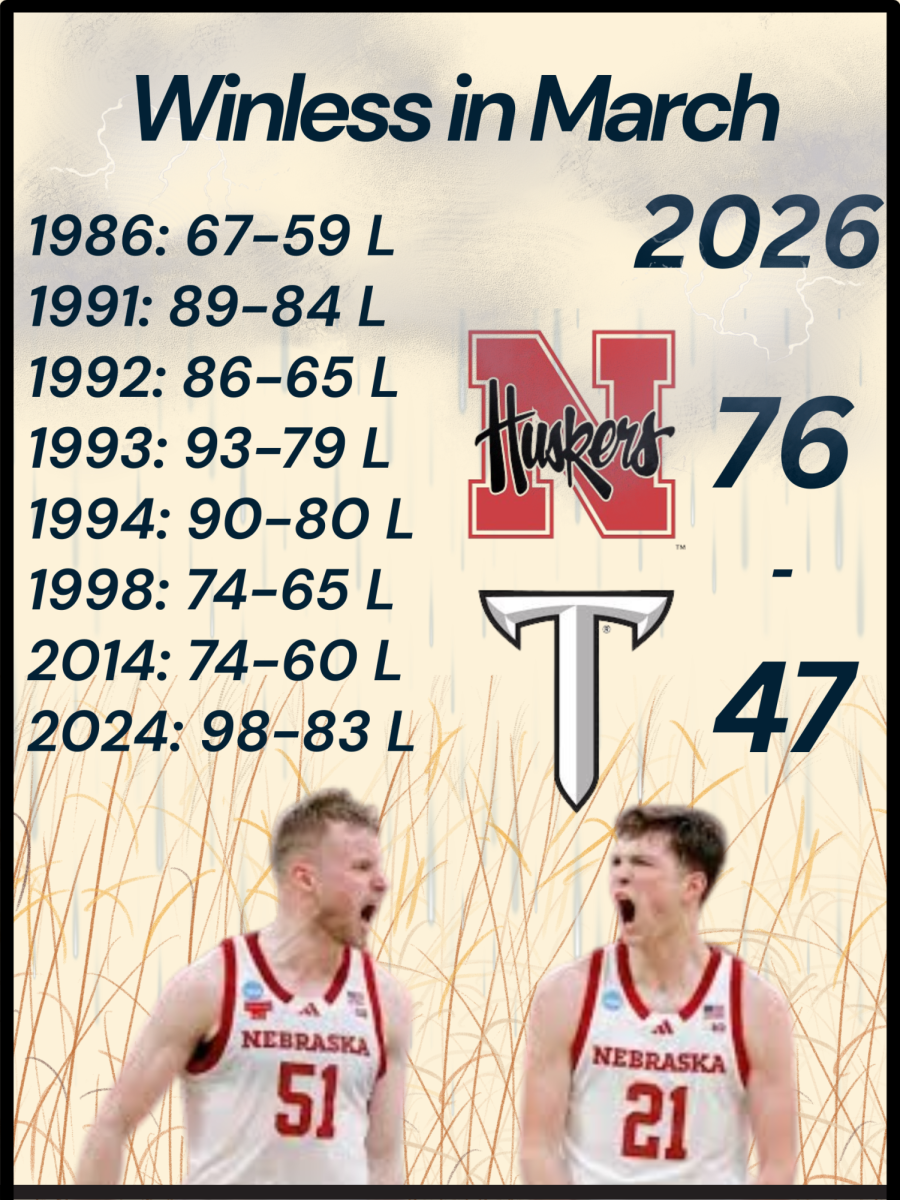
On March 19, 2026, Oklahoma City, painted scarlet and cream, became a site of history for Husker fans as coach Fred Hoiberg and company routed the Troy Trojans 76–47, marking Nebraska basketball’s first-ever NCAA Tournament win.
For 87 years, Nebraska basketball had gone without a tournament win. During this drought, the program and its fans suffered through endless ridicule as the last Power Conference team without the seemingly elusive victory. On top of this, the team was picked to finish 14th out of 18 in the Big Ten. Despite these overwhelming odds, Husker faithful bought in and were rewarded throughout what became a love letter of a season.
Lincoln Southeast social studies educator, Dustin Wardyn has been a Nebraska fan his entire life, through all the good, bad and ugly.
“My love for Husker basketball and football occurred at the same time,” Wardyn said. “I was 10 years old, and I remember thinking that [Nebraska basketball player] Eric Piatkowski was incredible. He hit three-pointers, he dunked, he did it all.”
Piatkowski played a pivotal role for the Huskers from 1990 to 1994 during their Big Eight era. Under coach Danny Nee, he proved himself as one of the program’s greats. During that stretch, Nebraska made four consecutive NCAA Tournament appearances, earning a No. 3 seed in the 1991 Midwest Region. However, each time, the Huskers left empty-handed.
Although disappointing, the lows would come to far outweigh these moments.
“Regarding the team overall, the lowest point for me watching would have been either the 2002–2003 or 2019–2020 team,” Wardyn said. “It just seemed like we were getting crushed by everyone.”
The 2002–2003 season was one of many lows, as the team finished 11–19 overall and 3–13 in conference play. The 2019–2020 team, led by first-year head coach Hoiberg, fared even worse at 7–25 overall and 2–18 in conference play. However, in 2026, Hoiberg was named AP National Coach of the Year. In his first three seasons, he totaled just 24 wins, four fewer than this year alone proving that success takes time.
Despite the struggles, many could see what was building in Lincoln under Hoiberg.
“Regarding the program as a whole, I think it was Coach Hoiberg’s ability to enable players to maximize their talents,” Wardyn said. “If you go back to 2020–2021, the record was terrible, but you could see the offense starting to blossom with players like Dalano Banton and Teddy Allen. A couple of years later, you could say the same for Sam Griesel and Derrick Walker. Then players like Juwan Gary and Keisei Tominaga took on bigger roles. Throw in Brice Williams, and now you have a team good enough to make the tournament.”
Much of this shift was evident in the final stretch of the 2022–2023 season, when Nebraska won five of its last seven games to finish 16–16. Fan favorites like Derrick Walker, Sam Griesel and Keisei Tominaga led the way. That momentum carried into the program’s first NCAA Tournament appearance in nearly a decade. However, a 98–83 loss to the Texas A&M Aggies left many believing the curse remained unbreakable.
“Not to be melodramatic, but for me it was like being a Red Sox fan in 2004 or a Cubs fan in 2016,” Wardyn said. “As a fan, you’ve had to take the heartache time and time again. I remember all those first-round losses, and even worse, the times we just missed the tournament. But I came to find that hope is a powerful thing.”
Hope, in the end, proved to be everything.
“I was here at LSE, watching the game with my Criminal Justice and U.S. History students,” Wardyn said. “It was one of the happiest days I’ve ever had. With the atmosphere, it practically felt like a home game.”
Outside of volleyball, Husker fans have been starved of sustained success since the glory days of football. When Nebraska was sent to Oklahoma City, the city was washed in a sea of red. This support proved emotional for many, including Hoiberg, whose ties to the university run deep. His grandfather, Jerry Bush, coached the team from 1954 to 1963, and his parents are alumni.
“That was as loud and vocal of a neutral-site game as I have ever played in,” Hoiberg said. “When we went out for the anthem, I got goosebumps. I even got a little emotional just seeing how the fans showed up for us.”
More than 10,000 Husker fans made the trip, many traveling seven hours during the workweek. Their presence extended beyond the arena, as Oklahoma City’s economy saw an estimated $10 million boost, with hotels filling and nightly rates averaging $350.
The energy only grew for the March 21 matchup against the Vanderbilt Commodores. The Huskers prevailed again, as Nebraska freshman and Lincoln native Braden Frager drove in for the game-winning layup.
“Once I saw the whole team run at Pryce, I screened for the ball,” Frager said. “He made an unbelievable, unselfish play and gave me the ball with a wide-open lane. All I had to do was make a left-handed layup. I’ve made a million of those.”
“It felt like we were at Pinnacle Bank Arena again,” he added.
Even before Nebraska took the court, “Go Big Red” chants echoed during the Houston and Texas A&M game. Once the Huskers tipped off, that energy carried over. The arena home to the defending NBA champion Oklahoma City Thunder reached a deafening 115 decibels. In the streets, celebration spilled into Bricktown.
With the program’s trajectory shifting, the future looks promising. Breakout stars like Sandfort and Frager are set to return, alongside strong roster retention and incoming talent.
For many, this season has reinforced a simple truth: hope endures. And for Nebraska basketball, that hope has finally turned into something real, proving one simple phrase “in our grit is our glory.”