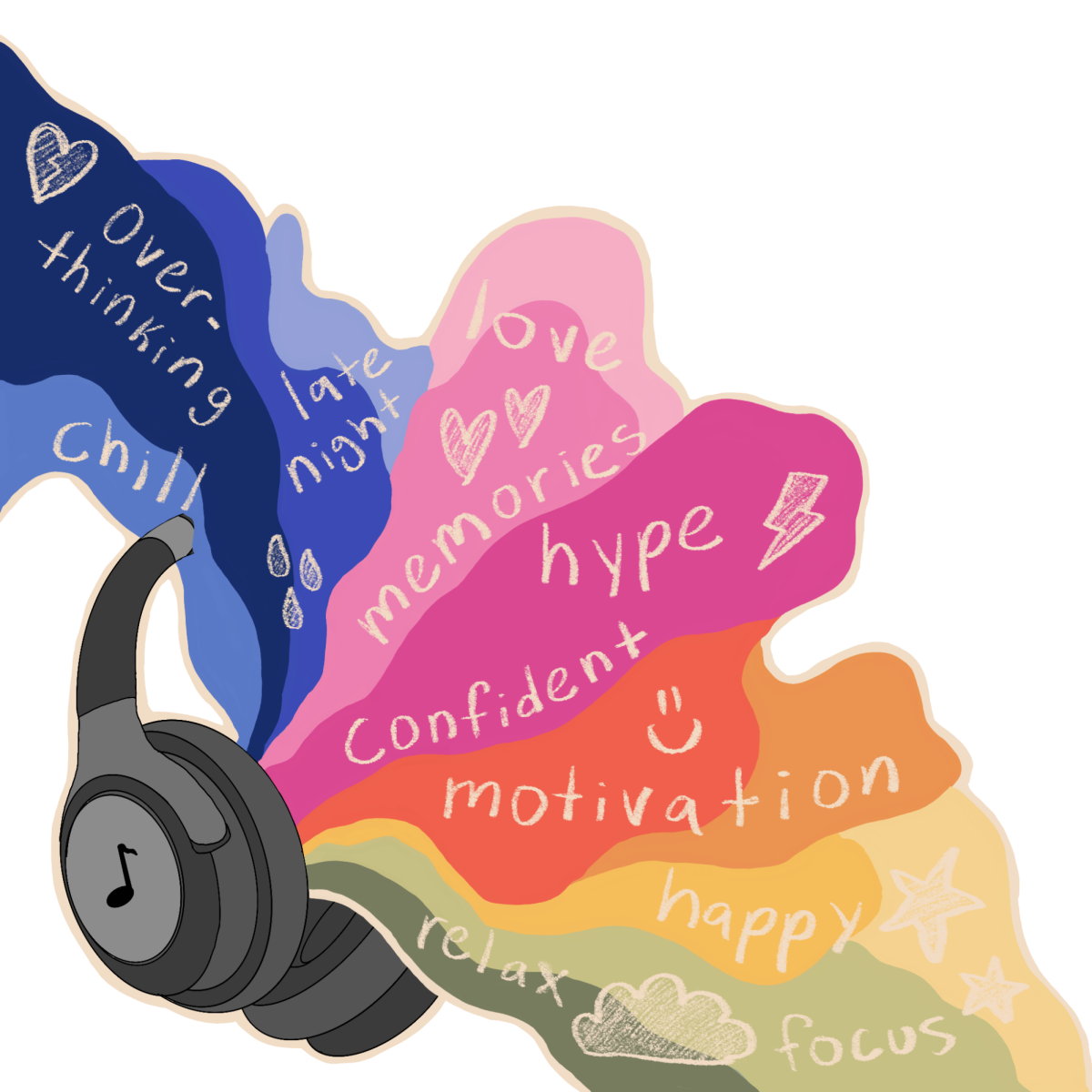
Before the day begins, many students have already made a choice that reflects how they feel, or how they want to feel. Scrolling through playlists labeled “hype,” “late night drives” or “main character,” they select music that sets the mood for the day. While it may seem like a simple habit, the act of choosing certain songs or genres can offer insight into a person’s emotions, routines and personality.
Music is widely considered a universal form of expression. Regardless of background or experience, people use it to process emotions, stay motivated and connect with memories.
According to a study published by the journal Frontiers in Psychology music activates areas of the brain tied to emotion and memory which helps explain why certain songs can trigger strong reactions or associations almost instantly.
Because of this, listening habits are often more than just a preference. It can signal things like the mood and personality of someone.
Research from the University of Cambridge has also found correlations between music preferences and personality traits, suggesting that while not exact patterns can exist between what people listen to and how they think or behave.
Pop music, for example, is often linked to outgoing and energetic individuals. Rock and metal listeners are frequently associated with creativity and introspection. Fans of classical or jazz music may show curiosity and openness, while hip-hop and rap are commonly connected to confidence and high energy. Country and folk listeners are often described as dependable and grounded, and indie or alternative fans tend to value individuality.
While these connections are not exact for all people, they highlight how some music choices can align with personal tendencies.
For many LSE students, however, playlists are less about personality indicators and more about daily function.
Freshman McKenna Honhensee said her music choices change depending on the situation.
“I like a lot of upbeat songs,” Honhensee said. “When I’m getting ready, it’s more upbeat, trying to get me ready for the day… just to be positive.”
She keeps multiple playlists for different parts of her routine, such as dance.
“I always have a certain playlist that sets the mood for the competition that I’m going to,” Honhensee said.
This type of intentional listening shows how people can use music to regulate a person’s mood. Studies from the American Psychological Association show that listening to music can increase dopamine levels, a chemical linked to motivation and pleasure. As a result, people often use music not just to match how they feel, but to shift it.
Honhensee said some songs have a strong emotional effect.
“There were a bunch of songs where it’s so emotionally deep that I will cry to it,” she said. “It just stays in my brain.”
Songs like these are often tied to specific memories or experiences. Hearing them again can bring back emotions connected to a moment, making music a way to revisit the past.
Freshman Sarah Algahimi said certain genres and artists can connect to both mood and personal experiences.
“My main playlist is called vegetation and within it I have artists like Steve Lacy, Blood Orange, Solange, and many other great RnB or indie pop artists,” Algahimi said. “I like that the style of music [r&b] is super versatile and you can find a song for any occasion.”
At the same time, music can communicate things that are not always expressed directly. Playlists can reflect confidence, stress, excitement or relaxation without a person needing to explain it. They can also reflect the mindset that someone desires to have.
“I like really positive songs, so I try to stay really positive,” Honhensee said. “I try to make the music that I’m listening to reflect what the mood is going to be for the day.”
However, music choices do not always match how someone appears to others. Some students describe using music as a more private outlet rather than something they always share.
“There’s definitely a couple that I just listen to alone,” Honhensee said. “There’s one song that I cannot listen to more than once in a day, or I start crying because it’s so emotionally deep.”
These listening habits show how music can serve both as a public and a private experience. A person’s regular playlist might highlight social energy or current trends in popular music, while a personal one can reflect more emotional moments.
Senior Jayden Dobesh-Jackson said he sometimes keeps parts of his music taste to himself.
“There’s definitely some songs I listen to alone, in all honesty I don’t like sharing my music taste at all,” Dobesh-Jackson said. “On another note, I’m not necessarily embarrassed, more or less scared of judgement by others.”
Additionally, playlists themselves provide insight. The way songs are grouped (whether by mood, activity or memory) shows how individuals organize their experiences. Some playlists are built for specific events, while others collect songs that represent different periods of time.
Honhensee described her music taste as wide-ranging.
“There’s Disney songs on there, there’s so many different artists and genres,” Honhensee said. “It could really show that I’m just chaotic, apparently.”
Algahimi said her playlists are also organized by situation rather than a single identity.
“I definitely have playlists for different situations, like r&b for studying, upbeat pop for working out, or even less common genres like cloud rap,” Algahimi said.
Dobesh-Jackson added that his playlists often reflect his routine and environment.
“I do have different kinds of playlists usually for relaxing, driving, [and] working out,” Dobesh-Jackson said. “I would say my driving playlist is one of my favorites. Driving is a big deal, [it gives me] a sense of freedom.”
That range is common among students, reflecting the variety of influences they experience. Rather than fitting into one category, many listeners move between genres depending on their mood or environment.
As music becomes more accessible through streaming platforms, its role in daily routines continues to grow. Whether it is used to prepare for the day, focus on a task or unwind at night, music remains a consistent part of how people both manage their emotions and express themselves.
“No matter if your music taste is a bit embarrassing or seems unfitting for your character, everyone should listen to what makes them feel good,” Algahimi said. “All that matters is that you like it.”