“Six-seven!” can be heard echoing across the room among the many other cheers and shouts of a student-filled gymnasium. At the basketball game, the score is close. Six to seven. The camera pans to the scoreboard, showcasing the numbers, then back to the child who hollered them. He’s doing a motion with his arms. What he didn’t know was that one video would become a viral sensation, and he would begin a worldwide trend.
Laughter has always had a way of bringing people together. Whether it’s through jokes, absurd
stories or the endless amount of memes online, humor gives people a way to connect, no matter the barriers. Memes specifically have reshaped the standards of what we consider as funny, turning fleeting moments or phrases into widely understood phenomena.
For something often dismissed as shallow, or even trivial, I’d argue that memes have become one of the most powerful forms of communication in society.
Memes are seen as quick jokes, designed to be consumed in seconds by an online generation. They are labelled as disposable and even simple. But that simplicity is exactly what makes a meme so effective when it comes to communication. A meme has the capacity to compress emotion, shared experience and culture into a single image, phrase or video: traditional language often struggles to do so.
Sometimes, that compression can turn into something bigger.
One meme in particular has managed to unite an entire generation. Scroll long enough, and you’re bound to come across it in the form of an image, a number or a motion. It doesn’t seem to make sense. It’s not supposed to. Yet for a younger audience, it’s instantly understood, no explanation required.
The meme “67” has grown into something far larger than a silly joke; it’s now a global meme. The trend originated from a rap song named “Doot Doot (6 7)” by American rapper Skrilla. The song repeated the phrase “six-seven,” which eventually blew up on TikTok, spreading through basketball edits, random memes and even a viral video of a kid–now dubbed as the “67 kid,” who yelled it at a basketball game. It’s deemed as a part of the “brain rot” humor and technically has no meaning and makes no sense, which is the joke itself.
“67,” and memes like it, have evolved beyond simple humor. Research has increasingly described these forms of humor as a “new language,” capable of expressing emotion, understanding and giving younger generations the ability to build connections in spite of any barriers such as language, culture or age.
I’ve seen this phenomenon play out firsthand on TikTok. In a trend with countless videos, tourists record interactions they’ve had with locals in countries where they do not share a common language. Rather than speaking to connect, they record themselves doing a gesture with their arms, waving them up and down as if they are weighing options. The person that they are making that motion to, despite the language and cultural barrier, understands immediately, and does the gesture back. Not a word is exchanged, yet the message is clear.
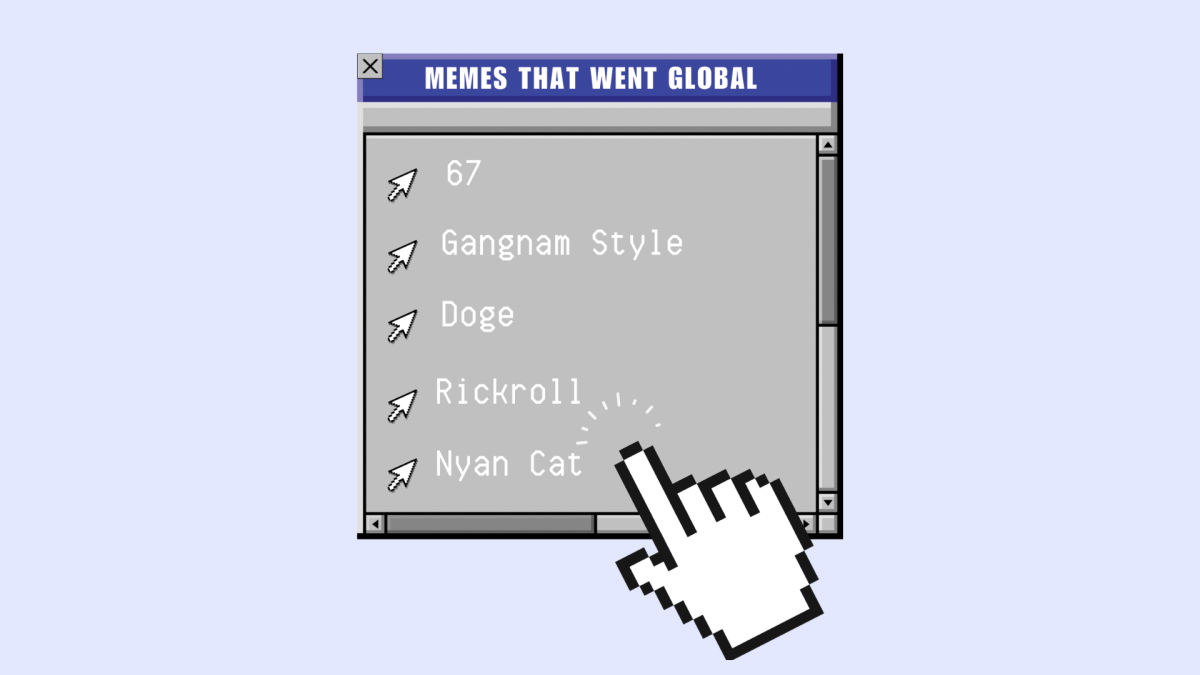
Many social media users are calling “67” the “universal language.” But this applies to so many more memes from the past. “67” is only the most recent example of it. Other memes from the past that went global are still known and even relevant today, like “Rickroll,” “Gangnam Style,” or “Nyan Cat.” The “Gangnam Style” specifically became a global sensation in 2012, breaking Youtube’s Live View Counter, and becoming a worldwide cultural obsession that is still widely known today all over the world. It’s a different language, a different culture, a different country, but the same understanding; it’s not about where you’re from. It’s about recognizing a moment.
Of course, memes aren’t perfect; they can become too simple, causing confusion with ideas where nuance is necessary. At first, I didn’t understand what “67” was or where it came from, but I knew that I thought it was absurd, and even funny because so many others were referencing it. To call memes shallow and dismiss their value misses the bigger picture. Memes are not replacing language: they’re expanding it.
Memes shift a prior focus on grammar and vocabulary towards one of emotion, relatability, and humor. In a world where language, culture and geography can cause divisions, this kind of communication is not only rare, but necessary, especially when it comes to communicating with people of different perspectives with completely different lives.
I truly believe that this shift, that this trend is immensely important. Younger generations have found a way of communicating without relying on a written language, or translation. We have found a way of building connections through laughter, through what feels like one massive inside joke. It speaks volumes about the flexibility of human interaction, and opens a door to an entirely new way of thinking about language, connection and understanding.
Sometimes it looks like a random number, and that’s okay. It says a lot about how adaptable humans are, and it shows that communication isn’t limited to one form.
That’s something genuinely beautiful, and I hope that we continue to let communication evolve in these unexpected ways, despite its possible silliness. Memes can still bring people together, and create a real impact.