For Nebraskans, opening the news lately has become a grim routine, as harrowing stories of domestic violence seem to circulate the news monthly. Most recently, on April 7, a man in Polk County was accused of kidnapping and assaulting his wife, whom he was divorcing, after he killed a man she was with.
This is not an isolated incident, and it is not connected to Polk County alone. According to the Lincoln Police Department’s 2025 annual report, violent crime rose by 32% despite overall crime decreasing. Several of the city’s six homicides in 2025 were domestic-related murder suicides, Lincoln Police Chief Michon Morrow said in a police briefing.
But domestic violence is not just an adult issue discussed in courtrooms and police reports. Experts say many of the same patterns appear in teenage relationships, often hidden behind social media posts, location sharing and undeveloped understandings of love and consent.
WHAT IS DOMESTIC VIOLENCE?
Domestic violence, also called intimate partner violence, is a cyclical pattern of abusive behavior exhibited by a romantic partner. While physical domestic violence is often what makes the headlines, Lincoln psychologist and sexual abuse specialist Dru Beeman says that abuse can begin long before physical harm occurs.
“It usually starts as emotional abuse. It’s controlling. Phrases like: ‘I don’t want to go out.’ ‘I don’t know if I’d wear that.’ ‘You’re kind of calling a lot of attention to yourself…’ Those are really controlling behaviors that are just as abusive as hitting. It’s also coercion.”
Although teen relationships can become violent, emotional abuse can often be a more prevalent form of domestic violence in adolescents.
DOMESTIC VIOLENCE IN TEEN RELATIONSHIPS
Domestic violence can escalate from high school to college and adulthood but, “that doesn’t mean that things are less volatile in high school,” Melissa Wilkerson, UNL’s Center for Advocacy, Response and Education director, said.
Just as with intimate partner violence in adult relationships, in teenage relationships, violence can take a multitude of forms because, according to Wilkerson, “there’s really not a one size fits all cookie cutter version of it”.
As domestic violence is experienced differently by different victims, these victims can find themselves in these relationships for various reasons.
“Sometimes it’s because that’s the pattern they’ve learned in some way,” said Beeman. “They’ve learned that it’s okay to be treated like that in a family unit. It can be more of like their needs are dismissed a lot, or [they are a] people pleaser. It can be that pattern that leads to the relationship. It can also just be that they get sucked in.”
Ultimately, according to Beeman, the only thing which is true in all situations is that, “it’s not your fault when you get abused. That’s just the nature of the relationship.”
Experiencing domestic violence at such a young age can have a major effect on one’s future because adolescence is about identity development, Beeman stated.
“[Teens] are having [their] first relationships,” Beeman said. “It’s the first time you fall in love. It’s the first time you know what dating is, and you’re creating some templates that you carry with you. So if your first template in a dating relationship is violent, then that’s what you’re comparing things to.”
A particularly concerning aspect of experiencing domestic violence as a teenager is its effect on one’s self-image.
“It can have a lot of impact on how you see yourself and how you think other people see you because somebody has warped your reality,” Beeman said. “Somebody has told you you’re not worthwhile or told you it’s all your fault over and over and over. And not just any someone, it’s someone that was supposed to be your safe someone. You’re, ‘I love you more than anything,’ someone. And that’s a real problem.”
The effects of domestic violence are experienced because of a multitude of unhealthy behaviors.
UNHEALTHY BEHAVIORS
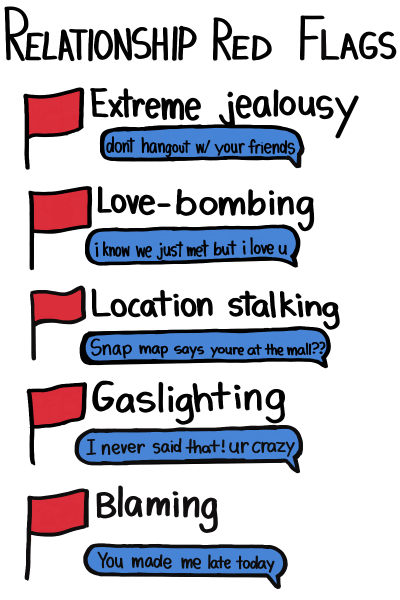
According to Beeman, unhealthy behaviors in relationships at any age include extreme jealousy, location stalking, threat of violence and intimidation, blaming their problems on their partner and love-bombing. Many of these actions can act as “red flags” of a domestic violence situation or a relationship which may be moving towards that. These same behaviors can be greatly encouraged by social media.
For example, location tracking can be accessed through the Life360 app, iMessage location sharing capabilities and Snapchat Maps, something which didn’t exist for previous generations.
“I did not grow up with a cell phone. We didn’t, couldn’t share location, because that didn’t exist. Now, everyone has a cell phone and everyone shares a location,” Wilkerson said.
While sharing one’s location is often a choice of the sharer, especially for safety reasons, it can lead to unhealthy behaviors such as stalking and extreme jealousy.
“If I say, ‘hey, partner, I’m going outside with my friends, and we’re gonna go to a movie and out to dinner’, you don’t need to show up at the movie and the dinner. That’s lack of trust, lack of boundaries,” Wilkerson said.
Social media can also encourage jealous behaviors through social media posts by romantic partners.
“Just because you put someone on your social media, especially in a friend group, [it] doesn’t mean anything’s happening, but jealousy can come up,” Wilkerson said.
Social media is also harmful towards teens experiencing domestic violence as it can reinforce unhealthy relationships. For example, Wilkerson cites “highlight reels” as a major factor of this perpetuation. Posting highlight reels is the action of solely posting the best part of one’s life; an action which most social media users take, Wilkerson said.
This becomes concerning when it is a person who is experiencing domestic violence posting highlight reels.
“Who puts the worst of their life on [social media]? Not very many people. So, I think that when we reinforce unhealthy and unsavory relationships, by being like, ‘oh, you’re so cute,’ ‘so perfect’…And yet the same people, they aren’t there. We’re coming here on our phone, social media, [talking] about how great something is, even though we’re seeing this other side of the relationship,” Wilkerson said.
In addition to social media’s harm to victims of domestic violence, the media also has a large effect on the general public’s perception of domestic violence, which has potentially led to increased desensitization of media consumers to domestic violence.
DESENSITIZATION
Hateful comments plague the pages and posts on most social media sites. Posts about domestic violence, a serious topic, are not immune.
“If you wanted to go on any platform, you can look at a news article post around sexual violence, relationship violence, and the read the comments. It’s absolutely awful what people say,” Wilkerson said.
These types of comments are particularly worrisome because they signal a desensitization of media consumers towards domestic violence.
“We have people who are commenting on, liking and things like behind a keyboard,” Wilkerson said. “They’re going to be desensitized. These are real people. This is not just a flat story. There’s real individuals that are being impacted.”
This desensitization and negative attitudes towards domestic violence aren’t confined to comment sections alone though. Social media has noticeably been filled with an abundance of posts joking about domestic violence, from jokes about a person beating their significant other to posts about people manipulating their partners, specifically through gaslighting. However, while these jokes receive a lot of attention, they are overall negative.
“Sexual violence is never funny. Relationship and dating violence, never funny,” Wilkerson said. “A joke that causes harm is not funny. It’s not a joke. It’s harmful.”
Jokes about domestic violence are especially harmful considering the mass amounts of people who view this content.
“We promise you survivors are listening,” Wilkerson said. “Survivors are everywhere. Given the number of people that are impacted by violence and sexual violence, survivors are everywhere, they will hear you.”
According to Wilkerson, this desensitization can be both through and because of such posts and jokes, as well as through other media people consume, like television and music.
“I do think we need to think about all that we’re taking in and does that desensitize us to what’s really happening, whether it be through music we listen to, whether that be through the shows that we watch, the social media that we pay attention to [or] the people we follow,” Wilkerson said. “What are we feeding ourselves? And then is that changing how sensitive or not we are to those issues?”
For example, Wilkerson suggests the Netflix show “You” shows a distorted view of stalking and violence. Although the plot of “You” is intentionally told through the perspective of an “unreliable narrator” Joe Goldberg, and many viewers may realize this, Goldberg still romanticizes stalking women he is infatuated with, viewing it as a noble pursuit.
Music can also romanticize domestic violence, even if it is meant to be a social commentary or to raise awareness of a victim’s own issues with romanticizing their abuse. For some listeners, this nuance may be lost, and they may only understand the surface level romanticization or potential promotion of such ideals.
One example of this is the music and criticism of popular artist, Lana Del Rey. Specifically, Del Rey has been accused of romanticizing domestic abuse and toxic relationships in one of her early albums, “Ultraviolence”. Although Del Rey has argued she is portraying realistic and complex emotionally abusive relationships, some listeners may not perceive this viewpoint, especially young girls, who are often one of her highest demographics.
Another example is the music of rapper Eminem, an artist greatly popular among young men. In songs such as “Love the Way You Lie” and “Kim”, Eminem sings about graphic depictions of physical abuse. Once again, while some argue he is bringing light to the cycle of abuse, critics believe he is joking about and glorifying domestic violence. For young boys listening to his music, the messages of his songs may seem to promote domestic violence, which is concerning considering that according to Beeman, the largest number of domestic violence perpetrators are men.
From desensitization to unhealthy behaviors perpetuated by social media, both Beeman and Wilkerson want teens to understand how a relationship can turn toxic, or even abusive. Wilkerson wishes more people would discuss these problems as both preventative action against and normalization of domestic violence.
“I wish we would have more conversations,” Wilkerson said. “How great is it to be able to sit around with your friends and talk about healthy and unhealthy and have it be normal versus a scary thing?”