
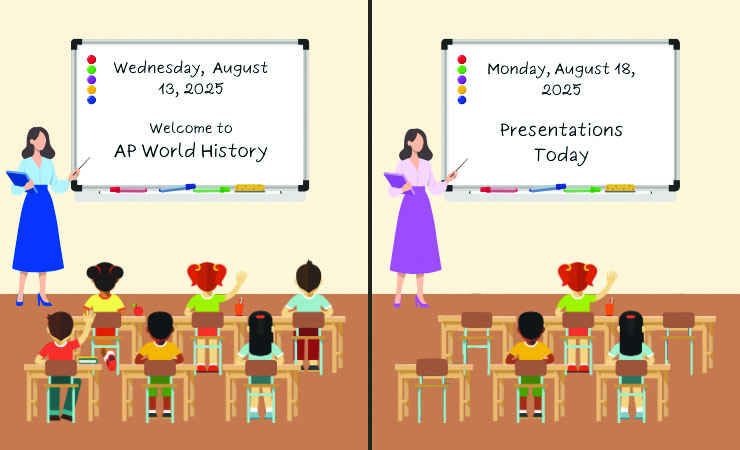
Hundreds of students at LSE start the year in Advanced Placement courses, but many don’t stay. Within the first few weeks, Advanced Placement courses see some of the highest drop rates as students realize what is really required of them to succeed.
AP classes promise college-level rigor, college credit and an academic edge for high school students, but the demanding assignments, reading requirements and schedule conflicts mean that not every student can keep up with the work. AP teachers say the early drops reflect the challenge of balancing seven or eight high school courses with work, sports and extracurriculars, which is a load much heavier than most college students face.
Classes like AP World History, AP Research, AP Human Geography and AP Calculus are commonly dropped for many reasons. The most common reasons behind these drops are the fast pace, heavy workload and scheduling conflicts with other classes or extracurriculars.
Students in AP Human Geography, typically a freshman level class, have already felt this stress. APHUG is a college-level course that includes topics like human interactions with their environment and spatial organization of the world. It is the first AP class offered to students, and with the transition from middle school to high school, in addition to the introduction of AP classes, it can be a difficult adjustment for students.
“Students realize it is more demanding than they expected,” APHUG teacher David Peters said. “APHUG is not just ‘ninth grade diff,’ but it is supposed to be a ‘college-level’ experience.”
Considering the students taking this class are usually 14 or 15 years old, it can be a lot to expect their learning level to be equivalent to that of an 18 to 22 year old. In addition, most college students take four to five classes per semester, compared to the seven or eight classes taken by students at LSE.
It is not just APHUG that sees these drop rates. Other classes, like AP World History, are also affected. According to the College Board website, AP World History: Modern is a college-level history course that covers events all around the world from 1200 CE to the present. The course goes at a fast pace, and requires reading quizzes two to three times a week, proving to be a challenge to any student.
“I knew it was the hardest course in this high school, and I wanted to see if I could do it,” junior Lena Coley said. Coley dropped AP World, along with 40% of students who were originally enrolled in the class, according to AP World teacher Chad Blatchford.
“It does require students to read a college level textbook, quiz over their readings, and complete additional daily work for the class,” Blatchford said. Another reason for these high drop rates, according to Blatchford, is that the course is not offered as a “dual credit” course. This means students have to take the AP Exam to earn college credit, compared to other courses where they can get credit through Wesleyan University without taking the exam.
The whole year of class prepares students for the AP Exam at the end of the school year. This exam is scored on a scale of one to five, and if a three or above is achieved, students have the chance of receiving college credit, depending on what college they attend.
“At LSE we have extremely high numbers when it comes to success on the exam,” Blatchford said. The national pass rate for the AP World exam, meaning a score of three or above, is 53%. LSE’s pass rate is 88.1%, according to Blatchford. This drastic difference shows the success of LSE students in AP World.
Senior Vincent Taddeucci has taken many AP classes in his high school career, including AP World.
“It was difficult, but I learned a lot. And I thought it was a fun class,” Taddeucci said. While taking AP classes, he was able to participate in both club and high school swimming and continue to get good grades. Taddeucci only had to dedicate 45 minutes every other day in order to stay on top of his classwork for AP World.
“For students who worry too much about grades, I encourage them to take the class pass/fail,” Peters said.
Taking classes pass or fail, especially difficult and demanding ones like AP classes, can be helpful. Students can still get the challenging and rewarding class experience, without worrying about their grades.
Some students think counselors and teachers should be sharing more information about AP classes when they are signing up for them. This is especially important when students are deciding to take APHUG at the end of eighth grade.
“[The counselors] didn’t really dive into the difference between Diff and AP,” junior Wysteria Hopkins said. Hopkins dropped AP Human Geography his freshman year, and is currently taking AP Language and Composition and AP United States History.
More transparency while signing up for classes would help students get a better idea of what they are getting into, and understand how much work will actually be required of them.
“In an effort to recruit more kids into the AP system, some middle schools might be slightly over-enrolling eighth graders,” Peters said.
This over-enrolling can lead to both increased drop-rates when students actually begin the class the next year, but also give more students the opportunity to challenge themselves.
“I think it is great to get more students exposed to AP courses,” Peters said.
While these classes are difficult, they can also be very beneficial and interesting. It is an opportunity for students to be exposed to college-level work, while having lots of support from teachers and the chance to change their mind if it becomes too much to handle.