
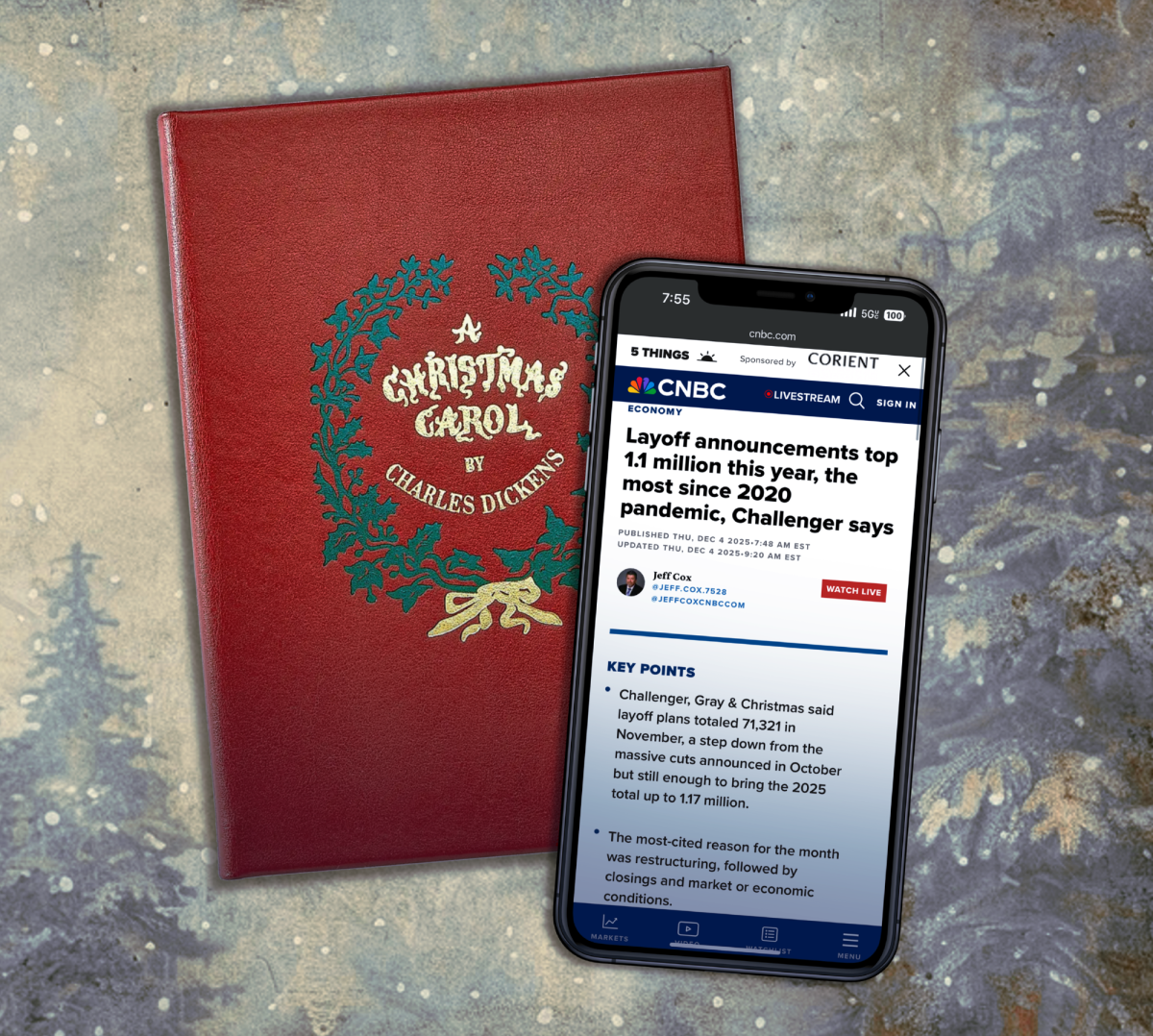
Cloaked in darkness, student actors stand packed closely together backstage, awaiting their next cue with baited breath. The play they’ve been working on for months is finally coming to fruition. When the curtains lift the audience is immediately sucked into a familiar tale of ghosts, greed and haunting Christmas cheer. The characters move across the stage, speaking and dressing in ways that haven’t been practical in a hundred years. There’s no doubt that the play is a complete work of fiction. But despite all of this, the story, at its core, couldn’t be more relevant to modern audiences.
The LSE Theater Department performed their winter play “A Christmas Carol: A Ghost Story of Christmas” on Dec. 5, 6 and 7. Behind it all was Director Kathryn Frankforter, someone who, like many, has a connection to the iconic play.
“One of the first productions I was ever a part of was a production of “A Christmas Carol,” and I have such fond memories of that show, and being a part of a wonderful cast telling a classic story,” Frankforter said.
Now, all these years later, Frankforter has chosen to pass the show onto the students of LSE. After the theater department has produced several modern musicals and comedies, “A Christmas Carol” presented itself as the perfect, festive opportunity to broaden LSE’s theater horizons.
“This was an opportunity to challenge our actors and technicians to work with a different type of story, with more emotional weight,” Frankforter explained. “Our actors are taking it in stride. They are diving into the unique language of Charles Dickens, and taking their roles seriously.”
Though there are hurdles which come with the teenagers of today adapting Victorian era fiction, Frankforter says that “[students] have been comparing the themes of the show to real-life news and experiences”.
These revelations are coming to the students now that they have to study the material and perform it, but for most it has been a childhood staple.
As children growing up with the story, Ebenezer Scrooge seems cartoonishly evil and selfish. However, as informed young adults, today’s teens may wonder if Scrooge is actually far off from real life millionaires which society clashes against daily. This is not much of a coincidence when the rich and powerful figures of today have proven to be as selfish and greedy as the rich and powerful figures of the 1800’s.
When looking at the whole of Dickens’ work, the clear, outstanding common theme is poverty; specifically how poverty is the fault of the rich, not the poor. In “A Christmas Carol”, not only is Scrooge cruel and unforgiving towards the poor, but he intentionally takes from them for his own benefits.
A 2025 Oxfam report on financial inequality in the U.S. states that “the 10 richest U.S. billionaires gained nearly $700 billion dollars” within the past year. The same report also states that when compared to peer countries “the U.S. is dead last in generosity of unemployment benefits, second-to-last in public spending for families with children, seventh out of 10 in public social spending overall, and number one for working hours needed to exit poverty.”
This data is no surprise when the average American can take a step outside and see these numbers translate into everyday life. The government recently shutting down due to inefficient government spending has caused several problems for citizens all over the country, one notable instance being the hold on Supplemental Nutrition Assistance Program (SNAP) benefits.
Food was one of the specific things that the poor struggled with in the Victorian era. Because of the rapidly booming Industrial Revolution and non-existent food safety laws, the food intake of poor individuals of this era was detrimental to their health, causing foodborne illness and lacking nutrition.
Now, especially with snap benefits and food resources dwindling, many people with low budgets have to resort to the cheapest, most convenient sustenance: junk food with no nutritional value.
Not having access to safe food based solely on economic status is inhumane, but its not where the comparisons end. For example, in both the Victorian era and 2020’s, there have been problems with overpopulation, explosive technological progress which leads to more economic hardships, and shrinking government aid, etc.
When acknowledging these facts and the economic state of the U.S., it is easy for one to draw similarities between Dickens’ ideologies and the real world. And while Scrooge might be the more gritty, realistic character in A Christmas Carol, Frankforter thinks that Gen Z could learn more from a different character; Fred, Scrooge’s nephew.
“Certainly modern audiences can resonate with Scrooge and his need to collect more wealth. Our inclination to work ourselves to the bone is often ingrained in American audiences,” said Frankforter. “[But] at the end of the day, young people want to get excited about something, want to laugh, want to be merry. Fred is the embodiment of that.”
While going through complicated times with the stress of politics, social media and division, Gen Z has been known to make light of dire situations. This is done through humor and finding unity. Right now on TikTok users can find thousands of videos of teens joking about the job market, student debt, or mogging into the camera with bleak text about politics over top. And while it might be better for Gen Z to take these problems seriously, there’s no doubt that humor brings younger generations together.
Though humor is a big part of Fred, an even more prominent attribute is his motivation to not give up on others. This is seen through the way that he continuously tries year after year to get his uncle Scrooge to open up his heart and be more merry, regardless of how Scrooge treats him.
If teens and young adults today were to adopt this hope in others, the world would look a lot different, and maybe taking on hardships such as political chaos and economic stress would be more bearable.
At the end of A Christmas Carol, Scrooge is ultimately able to change his selfish ways. This growth is solidified by how he rights his wrongs with the poor, a group of people that he previously looked down upon.
Finding a way to extend kindness to those outside of your bubble, much like Scrooge did, is crucial to a more fulfilled life. Whether that means making a huge leap in breaking away from a religion or politician you idolize in order to hear others out or simply talking to people from a clique you’re not accustomed to.
Of course, a complete mindset 180 like Scrooge experienced isn’t realistic. Gen Z can’t change their attitude overnight and there will always be hardships. But one easy step for teens to take is simply to look deeper into the shows and movies that they love and reflect on how they mirror real life. It could potentially do a lot of eyeopening.
Though Frankforter picked A Christmas Carol mainly because it’s a classic tale with great student opportunities, she herself also finds that there are important messages to take from the story.
“Accruing wealth can’t be our only goal as a society, or else we lose kindness, empathy and a sense of humanity,” Frankforter said. “Togetherness and community will always outlast hoarded wealth and financial success.”
The LSE drama department has shown to take these lessons to heart. One way that they are uplifting others this season is by fundraising for and doing Salvation Army Angel Trees, making sure that underprivileged kids and individuals have a magical Christmas during a time in need. Not only is A Christmas Carol an ever relevant tale, but fighting misfortune with generosity is timeless.