
For any LSE scientist seeking to expand their horizons and explore beyond what their science class currently teaches, they now have such an opportunity. This year marks the first year for the LSE Science National Honors Society (SNHS) chapter.
The idea for a SNHS chapter at LSE began last year when senior and Physics Differentiated student Eloise Carter noticed a lack of extracurricular opportunities for those interested in science.
“I just saw a science club happening at another school and [thought], why don’t we have something [like that]? So I brought it up to Petersen and since I brought it up, I got to be president,” Carter said.
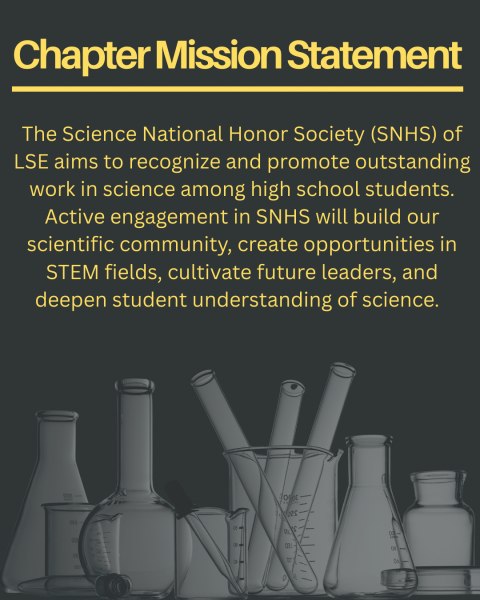
Previously, if a student wanted to get their fill of science, some options were taking a more advanced classes such as Advanced Placement Chemistry or joining the Science Olympiad competitive team. Both opportunities can fuel a student’s passion for Science, but are limiting in their own right. The SNHS allows for much more flexibility when it comes to how students expose themself to different subcategories of science. Advisor of the LSE SNHS chapter Frances Petersen expresses some of the benefits this allows.
“[T]here’s lots [of] opportunities that come in that don’t fit [a] normal [class] curriculum, or a [speaker] doesn’t want to have to [visit] six class periods, they can come for just one period,” Petersen said.
One of the “opportunities” of the LSE SNHS chapter means that now LSE students are in a group of young scientists both nationally (with 1275 SNHS chapters established around the world) and right in their own school.
According to the official website for SNHS, the organization aims to “engender a new group of young thinkers who will be the future of industry, research, and scientific exploration for America.”
One of the Vice President’s of LSE SNHS, Junior Valenciano, says that it is a tight-knit community where people can come together that are interested in doing science in high school and beyond. The group also invites guest speakers to their meetings. Previously, the SNHS had a UNL engineering student come and talk about their field of work. The speaker used a diagram of a spaceship to show all the different types of engineering that occurred in such a feat. Such as airspaces, chemical and mechanical.
“I think it’s just helpful to be able to go a little bit more in depth and see a little bit more of how science is actually practically applied, and how it translates [to] jobs and people’s futures because you don’t really get that in classes,” Carter said.
Another guest speaker was LSE alum Cadence Carlson and current Nebraska University student, who has done genetic research on yeast. Carlson was trying to see if, over time and over hundreds of generations, if yeast could be adapted to use another source of food other than glucose (commonly called blood sugar). Potentially helping those who have difficulty processing it on their own.*
Senior Jeffrey Ogbonnaya said one of his favorite guest speakers was Dr. Mark Gripe, who talked about the chemistry of movie aliens. Gripe, a professor of Chemical Education at the University of Nebraska-Lincoln, who has done extensive research on how elements of science and chemistry have been taken and transferred into some of the most popular movies.
“[He] had the example from Men in Black, Superman, and different fictional chemical compounds, but then he used real life chemistry to kind of explain how they would function or what the science behind them is,” Ogbonnaya said.
Although it is helpful when experts in their field come and talk to LSE SHNS there is a bit of a barrier between student and speaker. That is why the LSE SHNS has asked their officer to pitch in and bridge the gap.
“Every officer is going to give a lecture on a different science topic that they’re interested in,” Carter said. “I feel like when it’s always like professors coming in, it kind of can feel inaccessible. But if it’s kids that are our age talking about it, it’s a lot easier to [say], ‘Oh, okay, I’m super [into] science too’.”
In addition to presentations by professors and peers students will be able to emerge themselves in more “opportunities”. They may be able to help judge Elementary Sciences fares, indulge in high school research projects, and be able tutor their fellow students before final week. Also the SNHS will help set them apart when applying for colleges, and there are scholarships (such as the Arepil-Karumuir Family Grant) that can be obtained with being in and through SNHS if a student shows significance in investment sciences. Also students will be expected to earn the titles of SNHS members through hard work, dedication and a point system.
“It’s 10 points to be an active member and officially be a part of it. We really want to encourage people, not just to be technically in it, but really get involved,” Carter said.
Points can be gained through going to lectures, attending the club’s monthly meeting and volunteering hours (minimum of four hours a year needed). Also, all students are expected to be involved in a science class each semester and successfully complete one advanced science class (Differentiated, Advanced Placement ect.) and maintain an overall non-weighted GPA of 3.0 and 3.5 in all the science classes. If a student is able to achieve these requirements they will be recognize at graduation and may get a Tassel as well. Although for many students it is more than just their name being read at graduation, a shiny addition to their cap and gown or saying they were in an extra curricular activity.
“I think it’s important to have things like that, because like it’s easy to learn about, valence electrons and [science] law[s] in the class, but like when you actually see it in real life, it helps it become more, ingrained knowledge, [and] know how it works in your life.” Ogbonnaya said.