
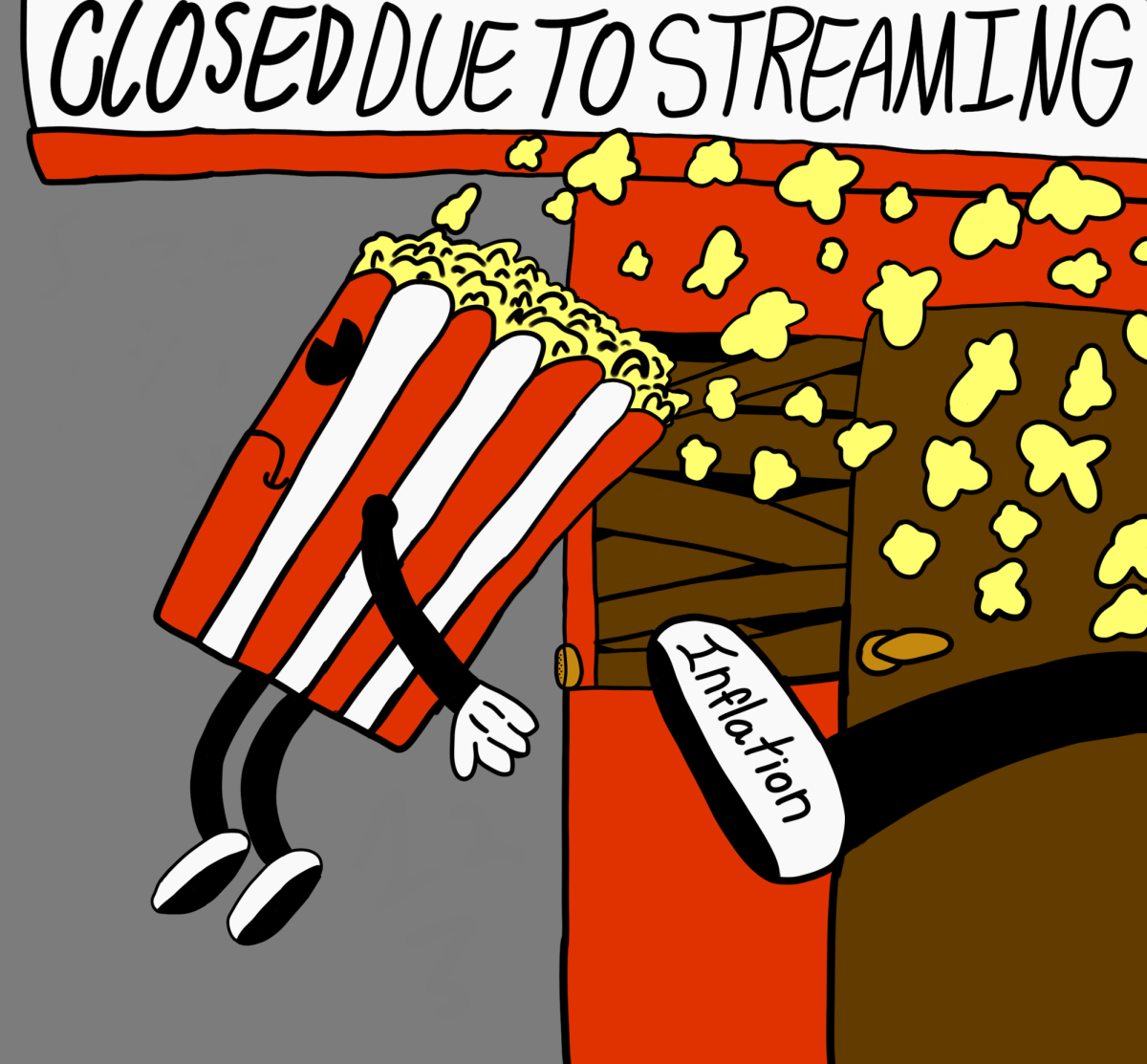
When the first ever public movie theater opened in 1905 in Pittsburg, Pennsylvania, nicknamed the “Nickelodeon” (named such after the admission fee costing only a nickel), movie theaters have become more accessible and grown extremely popular. But today’s a different story. With increasing inflation, the rise of streaming platforms and straight-to-streaming movies, and the growing prices for snacks, drinks, and admission, some people have begun to consider the question: Are movie theaters dying out?
LSE senior Clio Baird, an AP Research student; who is studying this exact topic, says theaters are struggling to compete as they become less profitable. She claims this has a lot to do with social media and streaming services.
“It’s just a lot more convenient for people to stay at home and watch a movie on Netflix or Disney+ than it is to go out and make a whole night of going to the movies,” Baird said. “Social media [is one reason why] people’s attention spans have really gone down, and so the appeal of even watching a movie that’s like what, a couple hours long, is becoming less and less desired by a lot of people.”
Despite the rise of short-form content online, movies continue to become longer and longer. Baird sees this as an inhibiting factor when people are choosing between watching shorter videos or staying seated in a theater for several hours.
“People tend to do what’s comfortable or easy, and staying in your own home, where you have access to streaming services or you can just scroll on TikTok and get the instant gratification [is becoming increasingly more common],” Baird said.
However, Baird also said that if a film is particularly interesting and would be more fun to watch in a movie theater when it is released, she would rather attend a showing than wait for it to come to streaming.
“If I’m going to watch a horror movie and if it’s in theaters, I want to go before it’s on streaming services,” Baird said. “I think in general, if I’m excited enough to be thinking about going to watch this movie, I usually wanna see it in theaters just cause I think it’s more fun. Like I’ll go with my friends, and it’s a whole big, fun experience for us.”
With that, Baird did say she would wait to watch films from certain franchises until they were available on streaming services, due to these entertainment companies releasing so many movies in a short span of time.
“I’m a big Marvel fan but there’s just so many movies that they put out, that I’m kinda just like ‘let me wait until it’s out on streaming,’ because I don’t want to go to the theaters every time they’re pumping out a new one,” Baird said.
Baird also noticed that some movie theaters have gotten into social media, such as Marcus Theaters.
“[They] do a lot of TikTok and Instagram posts, and that’s one way to reach out to a younger generation who maybe is tending to stay at home,” Baird said.
She also mentioned that lots of movie theaters are shifting their business models to maximize the number of movies that will attract the most crowds.
From the research that she has already completed, Baird has begun to discover an answer to the question at hand.
“They’re not dying. They’re not dead yet, but I will say the type of movie theaters that are dying out are the non-chains,” Baird said. “Smaller chains, family-owned, local ones, those are the ones that are gonna be like on the decline and having to put in a lot of work to compete, not only for the attention of the consumer[s], but to compete with the other, bigger chains that can offer a lot more movies to be shown.”
Seniors Tommy Liebgott-Osinga and Jones O’Donnell, two employees at the Marcus Theater at South Pointe, both feel like there is another issue at hand that is leading to fewer movie-goers: No good movies.
“The stream of movies has been really bad lately,” O’Donnell said. “It’s like most Hollywood movies have just fully dropped in quality.”
O’Donnell also said that the reason for this is because big producers are trying to widen the audience to appeal to everyone and it ends up appealing to no one, making people more wary about spending money on movies since the decline in quality.
“I really don’t get paid enough to care too much as long as it’s not egregious,” O’Donnell said. “It really isn’t too big of a deal to me.”
Liebgott-Osinga also said that he would prefer to wait for movies to go to streaming if he has doubts on if the movie is good.
A popular idea going around online to possibly help movie theater profits is lowering ticket prices. Liebgott-Osinga however, has other thoughts.
“I don’t know if that’s possible to lower that because film producers are spending more and more money nowadays to make bigger and bigger projects so then the tickets are going to cost more but it would make them more popular if they reduced the price,” Liebgott-Osinga said.
O’Donnell added onto that, mentioning that the prices are determined by the box office and are given to the producers while the theater’s source of income instead comes from concessions, which is why they’re so expensive.
Rising prices aren’t enough to deter all students, however.
“Personally, I think going to the movies is such a good experience and it’s worth leaving the house and getting out and interacting with other people and hopefully more people start doing that,” Baird said.