Nebraska workers rang in the new year with bigger paychecks as a sweeping wage law took effect, reshaping how much thousands earn, how young people enter the workforce, and how businesses train new employees.
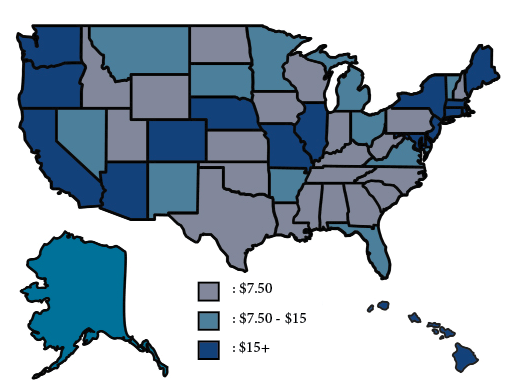
The law, LB 258 with amendment 272, took effect Jan. 1 and is expected to impact thousands of workers statewide. In addition to the wage increase from $13.50 to $15, the legislation ties future raises to inflation, mandates a “Youth Wage” and establishes a training wage for new hires. Together, these changes signal a broader shift in how Nebraska approaches entry-level employment, workforce development and the rising cost of living.
To address inflation, the law adds a provision in which the wage will increase annually up to 1.75% based on the Midwest Consumer Price Index (CPI). This was a conscious choice based on the Midwest CPI mean, median and mode over the last 10 years. Nebraska’s senators hope that this will account for the rising cost of living nationally, and relieve Nebraskan consumers.
The second part of this bill is known as The Youth Wage, a completely new provision which creates a $13.50 minimum wage for those 14 to 15 years old, which would also follow a 1.5% every fifth year.
The third and final component of this bill is the Training Wage, which dictates that beginning in 2027, a training wage will be 75% of the new Nebraska $15 wage for 90 days of being employed, which would be $13.50, rather than the federal minimum wage of $7.25. This raise would allow for young adults in training for a job to earn $6.25 more than they would have previously.
The first portion of the bill stems from Voter Initiative 433, a ballot measure approved to gradually raise Nebraska’s minimum wage from $9 to $15 by 2026 and to adjust it annually based on cost of living. However, the bill’s other two components – the Youth Wage and Training Wage – were later additions introduced by Senator Jane Raybould, who expanded the law beyond the original initiative.
Raybould represents District 28 of Lancaster County, and is a former member of the Lincoln City Council. She also works in her family grocery business, B&R Stores, as vice chairman and director of buildings and equipment. She shared that because of her background of working with and employing minimum-wage workers, securing this bill was a major priority during her term. She began the process by meeting with those who it would affect the most: members of the Lincoln community.
“We actually go out and do additional work and listen to the impact of bills on our voters, how it’s impacting their families, financials, how it’s impacting family businesses, how it’s impacting retailers,” Raybould said.
She focused especially on how the bill, with her additions, would positively impact as many people as possible in Lincoln, and how it would improve Nebraska as a whole. Raybould was also adamant about her specific additions, working to better the wage standard from her standpoint of experience, while also compromising with the will of the voters.
She also carefully considered the law’s impact on the market, particularly concerns surrounding inflation and the rising cost of living that often accompany wage increases. Raybould noted that some senators shared these worries, but she challenged their thinking with the undeniable responses from Nebraskan voters.
Raybould implied that her fellow senators disagreed with the bill in theory, until they truly read and understood it, and were positively swayed after considering the testimonies from Nebraskan workers.
She also feels that her past in business has primed her well for her congressional role.
“I’ve been a business person my entire life, I bring my business brain and I feel that I’m really well connected with my constituents, and I hear their concerns,” Raybould said.
Raybould made it her mission to balance constituent concerns and initial voter initiative with the business based needs of the market- but she also had new ambitions to allow for her bill to impact an even wider range of the working class, especially youth and young adults.
Two specific achievements of hers were that of the Youth Wage, which she created, and the major adaptations of the Training Wage, which affect the high school age group specifically.
Raybould said the Youth Wage was created to incentivize businesses to hire those 14 to 15 years old, especially because according to her research, “States that have had increases in minimum wage…show a decrease in the number of young people that are hired, only because of all the restrictions and prohibitions on them,” Raybould said.
She explained that this is due to the fact that youth are federally subject to a multitude of Occupational Safety and Health Administration (OSHA) restrictions, and therefore because of all the red tape around employing youth, “It’s really hard to justify paying them whatever that state’s minimum wage is at that time.”
She hopes that the Youth Wage will help businesses realize that despite the challenges that can come with employing youth 14 to 15 years old, as a result of such restrictions, the lowered wage (at $13.50 rather than $15), will increase hiring for this age group.
Furthermore, her adaptations to the Training Wage will serve to change the narrative for young Nebraska workers, as she believes it will also incentivize hiring in the 16 to 20 year age group. At the current standard, the Training Wage would be 75% of the federal minimum, only $5.47.
Raybould believes this rate is impractical. “Nobody pays that $5.47 an hour for 90 days. You couldn’t hire anybody for that.” Raybould said.
This also demonstrates the ways in which the previous standard was ineffective for hiring and keeping these young adult employees. However, now that the wage will be 75% of Nebraska’s standard minimum wage (or $13.50), she hopes to see increased engagement in the 16 to 20 age group, which will lead to greater productivity for the Nebraskan workforce as a whole.
Sophomore Makenna Kroeger, who works a minimum wage job, felt strongly about how this new wage growth has affected her.
“I put $200 in savings every time I get a paycheck, and it’s so I can save up and buy myself a car,” Kroeger said. “And ever since it went up $1.50 per hour, I feel like it has helped me reach this goal quicker.”
Another student, Senior Beau Cassell, commented on how the minimum wage increase has affected him, as a student planning to further his education after high school.
“The minimum wage increase has definitely helped me because I can still focus on saving for college next year while still being able to participate in extracurricular activities and hangout for friends. I don’t have to work as many hours but I still can be confident in my savings,” Cassell said.
These student’s stories demonstrate how this increase has the potential to positively impact the youth the most, while also circling back into the Nebraskan economy.
All in all, LB 258 represents a promising future for minimum wage workers in Nebraska, and shows the benefits of legislation that is directly founded on the will of the voters.