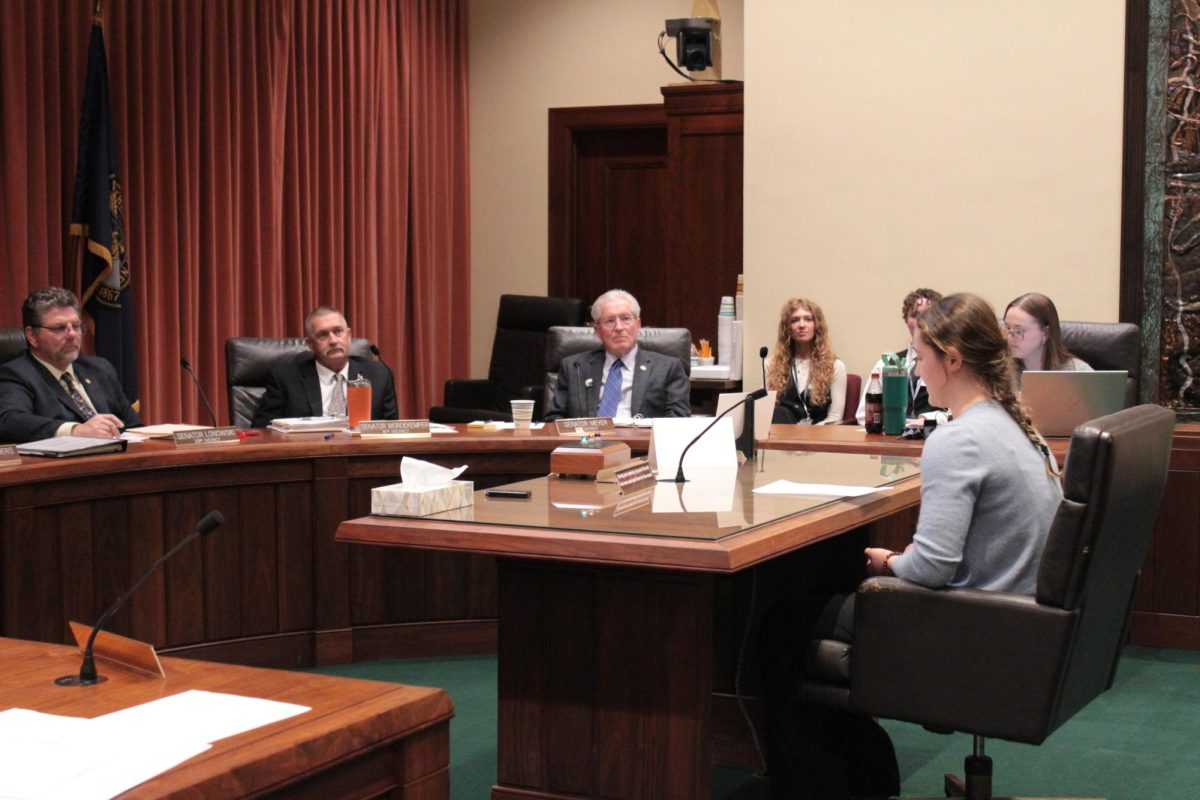
Inside of the capitol building, a committee room begins to fill with local Nebraskans, waiting to share their opinions and perspectives on important topics. Three constitutional amendments are proposed. After two hours of waiting, the last amendment is brought forward. The committee room goes silent as Senator Rita Sanders asks the room a vital question: “Are there any proponents of LR284CA?”. An LSE junior jumps at the chance to testify. In just three minutes, she must convey her point to the senators and show why, at just 17 years old, she should be allowed to vote.
On Jan. 22, junior Holly Bowen testified in support of constitutional amendment LR284CA. First introduced by Omaha Senator Terrell McKinney, this bill would amend current Article VI, Section 1, of the Nebraska Constitution, to lower the voting age in Nebraska from 18 to 16. If passed, the proposal would be offered on the ballot for Nebraska voters in the general election in November of this year.
This bill was introduced by McKinney in the hopes of offering youth the opportunity to have a greater say in choices which involve them.
“The intent of this proposal is to expand civic participation by giving young people earlier opportunity to engage in our democratic process, particularly on issues that directly affect their education, communities and future,” McKinney said in a press release.
McKinney recognizes that lowering the voting age is not a newly disputed issue but feels that the discussion is especially relevant with the influx of young people becoming more involved in politics.
“This isn’t a brand-new debate,” McKinney said. “But what makes it significant now is that we are seeing young people more engaged than ever before. Students are organizing, speaking out, testifying at the Capitol and paying attention to issues that directly affect their futures.”
One student engaging in their community is Bowen, who felt she should be more involved in order to make significant change.
“I went home one day from school, and decided that I was done being upset with the state of our country, and that I had to do something, because, especially being living in a time when social media and posting is so prevalent, I decided that that’s not enough for me,” Bowen said. “Sharing my views online wasn’t making the impact or other people’s views being shared, it wasn’t making an impact that I think they were hoping to have.”
Bowen began looking into the bill by doing deep research into the topic to ensure the issue “was something I supported and not just a way for me to get involved”.
With substantial knowledge of legislature from a family member, a talk with McKinney and an enjoyment of public speaking, Bowen decided testifying was the right choice for her.
“I think that that’s personally the best way for me to get my ideas across,” Bowen said. “Plus it’s a controlled environment. Everybody is eligible to testify. You just have to show up. It’s a very low risk, and in my opinion, high reward way for people to share their voice.”
Bowen began preparing her testimony with writing all her ideas in her Notes app but quickly realized she needed to adjust to fit her audience.
“That’s where a lot of the research came in, and just thinking through what beliefs do I have [that] can be best backed by evidence and facts,” Bowen said. “And what things are influential for a lot of people? What are my ideas that will speak to a greater population? What things are senators gonna care about, people that are voting on these issues, and other kids my age?”
With many ideas to follow, Bowen decided upon her final testimony by simply seeing what she could fit into her three minute window.
When the moment came for Bowen to testify, she said she wasn’t nervous at all, only nothing that it was something new for her.
“I talk all the time. And so it wasn’t a big change for me,” Bowen said. “I think it felt important to be there and to be part of that, but also… I’ve just been brought up in a family that’s very politically involved, and so it wasn’t something I’d done before, but it wasn’t out of the ballpark of things I’ve experienced.”
Bowen’s main points were about education and the future of youth in Nebraska. Bowen believes that if young people are going to stay in the state, then they need to see that their voices are heard and feel like they are part of the democratic process.
“[Young people] are smart and they’re not given enough credit,” Bowen said. “To disregard all 16- and 17- year olds is to disregard a lot of people. We can drive, we can hold jobs, we are as affected as voters are too.”
McKinney hopes to see more young people like Bowen become more active in local politics.
“Young people speaking directly to lawmakers is powerful, and it absolutely supports the point of this bill,” McKinney said.
McKinney encourages teenagers to speak up and fight for what they believe in.
“My final message is this: your voice matters right now,” McKinney said. “Even if you can’t vote yet, you can still make change — by learning about issues, speaking up, showing up at the Capitol, and staying engaged. Democracy is not something you inherit automatically. It’s something you help build. I’m proud of the young Nebraskans who are already leading, and I hope you continue to stay involved.”
(Lida Prochaska)