
The marching band plays LSE’s “Fight Song” during halftime at a football game, with students moving in their practiced formations. Students in the chamber orchestra sit on stage, their bows dancing over the strings of their instruments. Members of the Court Choir sing at a concert, harmonizing and showcasing the songs they have been practicing for months. Actors onstage perform during the opening night of their play, transporting the audience into a captivating story. Students proudly display the pieces they have created over the course of the semester at the Art Showcase.
Music, theater, visual arts. LSE has a large spread of arts programs provided to students that encompass a wide range of interests. However, for those who aren’t already involved in them, they can be somewhat overlooked by the student body. Something that can be observed throughout the country is that athletics often take precedence over the arts. It’s a tale as old as time. According to a study done by the National Endowment for the Arts, arts programs are always vulnerable to defunding due to their likelihood to be seen as secondary to other programs. However, in spite of national trends, LSE’s programs do not struggle with support from the school and the district.
“I feel like we do have really good support from the administration,” Maggie Delaney, LSE’s orchestra director, said. “I’ve gotten almost everything that I’ve asked for, [even] from the district level.”
What is true, though, is how this is reflected in our culture.
The societal imbalance between the arts and athletics is subtle, but noticeable if you start looking for it. On a large scale, professional athletes get paid millions more than professional artists. In the U.S., a professional football player makes an average of $3.2 million a year, while a professional musician makes around $53,000. Scholarships for various sports are much more abundant than scholarships for various arts programs. Athletic events typically have greater attendance than arts-related events.
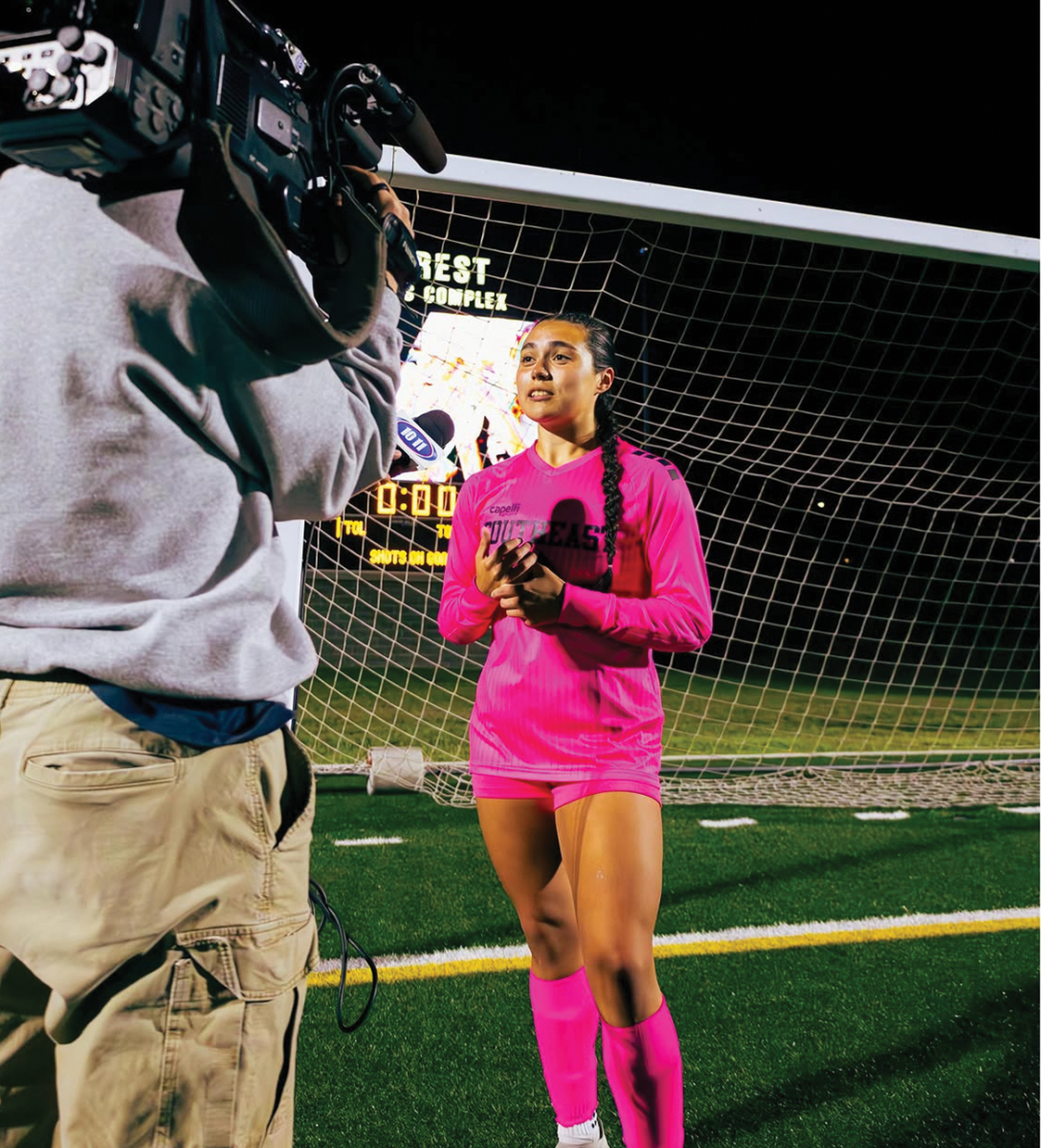
At LSE, this difference can be seen in several different areas. There is a hallway dedicated to cases and cases of athletic trophies and plaques, while there is only a single case for music awards. Pep rallies focus on members of sports, speech and debate teams, with almost no recognition for those in arts programs. During the marching band’s performance at halftime at a football game, many students use this time as a bathroom break. Attending football and basketball games is something almost every student does, even if they aren’t personally involved in those sports. The same cannot be said of attending a play, choir concert, art showcase or even Night of Knights.
So why is this happening? The root of this most likely comes from three different things: competition, atmosphere and home life.
“By nature, we are competitive,” Delaney said. “I think you just get to see that outward competitiveness in athletics a lot more versus [the arts].”
Having a team or person to root for can be more appealing to the average person than passively watching a performance.
That is not to say that there isn’t any competition in arts programs. Most do in fact have these opportunities, although it is not the main focus of those activities.
“[With athletics], there’s a level of competition that doesn’t always exist in arts programs, so it’s pretty easy to figure out who got first, second and third in a game of basketball,” Katie Frankforter, LSE’s theater director, said. “It’s not that easy to figure out who got first, second and third in an acting or art competition.”
This is due to the subjectiveness of the arts.
“A piece of art that I love might not resonate the same with you,” Frankforter said. “So awarding an appreciation of the arts is harder to quantify.”
Atmosphere is another key player in greater interest in athletics.
“Oftentimes, if you go to experience a performance of the arts, or to an art show, you’re often sitting there, expected to be quiet and consume the product,” Gary Shuda, LSE’s band director, said. “Whereas if you go to a sporting event, it’s often a social event where you’re able to talk to the person next to you.”
Excitement at sporting events is palpable – it’s socially acceptable to be loud and emotionally charged in those situations. It is not acceptable, though, to do this at a performance of the arts. Because of this, attending a sporting event can often be more thrilling than attending a play or orchestra concert.
Even phone usage differs between the two. It’s frowned upon to have your phone out during a performance of the arts, but it’s perfectly fine to do so at an athletic event.
A person’s home life is the final significant factor that contributes to their interest in the arts. Many people grow up playing sports for fun with their friends or family, and as they get older, that interest can continue through watching sporting events or playing on a team. With the arts, this is even more important. If you don’t grow up with a family who encourages an interest in creative expression, it can limit their participation in that area.
“Arts is harder to promote to people who are not already a fan, or who don’t come from a family that values and appreciates arts in general,” Frankforter said.
Having support from family is important, especially because many arts-related activities can be time-consuming and expensive (like orchestra, for example). Someone close to you who encourages your passion for an activity is going to make it more likely for you to continue engaging in it.
The greater cultural importance put on athletics can serve some challenges for arts programs in schools.
“Finding students from all corners of the building to come be a part of the program is getting more and more challenging,” Frankforter said.
This is often due to the idea that your ability to participate in school activities is limited.
“Sometimes it feels like, ‘When I get to high school, I can only do my one thing.’ And that’s just truly not the case,” Riley Herringer, LSE’s choir director, said.
In reality, every program, sports and arts alike, is willing to work with students who want to do both. However, there are still difficulties that arise when students do this.
“We kind of compete against each other for students,” Jessica Rice, the Art Department Chair, said. “Or [if] a certain activity is during the same time as another activity, they have to kind of make that choice.”
The idea of stereotypes can also be harmful in garnering involvement for arts programs. The concept of “theater kids,” “band kids,” “art kids” and more can be damaging to the perception of arts programs. These create a negative way of looking at those who are in these activities, and may make some students hesitant to join for fear of being classified this way.
“There’s a level of judgment that comes from people who don’t understand what it is we do in our arts programs,” Frankforter said.
This is the unfortunate reality arts programs face, which detracts from the many positives they provide.
“[Arts programs] are just a place for people to feel comfortable, welcome, be who they really are and express themselves, which is so important to have safe spaces to do that,” Herringer said.
“A lot of people find their place [in theater],” Frankforter said. “A lot of people find it in choir. A lot of people find it in pottery. There’s just these spaces that exist for people to find the community that they trust.”
The minimal focus on competition and the larger focus on self-expression and inclusion creates a unique environment in arts programs.
“Nobody sits the bench in the arts,” Herringer said. “I don’t mean that in a negative way toward athletics, but I do think that you can be as involved as you want in the arts without having to earn a spot.”
The benefits for academic success are also apparent.
“Musicians and artists think a little bit differently,” Shuda said. “They’re so used to having to think from a bunch of different angles, that it’s just a much different process and way of approaching the world when you’re participating in an artistic endeavor. And so that helps all the subjects, regardless of what it is.”
“If you’ve had to memorize a piece of music, it’s probably going to benefit you when memorizing something else down the road,” Delaney said.
Arts is a form of expression and talent that is life-long, not just for a person’s prime of life.
But arts and athletics have more similarities than one would think. There is a group of people preparing to perform their skill in front of an audience, who have a coach or director guiding them. They pour in hours and hours of time into readying themselves, and possess a passion for this activity. Recognizing sports and the arts as similar could help eliminate some of the attention disparity between the two of them. In fact, being in the arts often lends a hand to being in sports, and vice versa.
“Both performing arts and athletics require a huge amount of teamwork and individual accountability,” Delaney said.
“I’ve noticed over the years that students that are involved in athletics and theater really excel in both,” Frankforter said.
So how can students support the many arts programs at LSE? Well, it really comes down to participation and event attendance. First, though, it’s important to recognize that the arts play a huge part in our everyday lives.
“Every human being has a connection to the arts in some way, they just might not think of it that way,” Herringer said. “They might think of it as ‘I’m listening to the songs that I like in the car.’ Or, ‘I love watching this new show that was released on Netflix.’”
Thinking of it with this perspective can change the way a person sees the many arts programs out there. Even if someone doesn’t personally want to join an arts program, they can still be supportive by attending performances, concerts or showcases.
“I’d like for [students] to cross-pollinate and support each other’s events,” Shuda said.
Shuda isn’t the only one who feels this way.
“I think [myself and the arts directors] would always love to see more people at our events,” Herringer said. “We would love for [our students] to get the recognition that they deserve as well.”
If every student was a patron of the arts in some way, the discrepancy between the focus on athletics versus the arts would not be so great. The arts have suffered for decades because of American culture’s penchant for competition, but it’s just as important to celebrate individual growth.
“I think what I would love to see more of in life is cheering on accomplishments of individual humans,” Herringer said. “Less about competing against each other, and more about competing against ourselves.”