In a study conducted by the Centers for Disease Control and Prevention (CDC) from the last 10 years, nearly one in five high school students reported that they had been being bullied and were feeling unsafe inside of their school. Over seven percent mentioned they had been threatened or injured with a weapon on school property. Those numbers reflect a broader national concern, and ask the question of how safe students are inside of school walls.
Across the country, schools have responded with tighter security, more drills and increased supervision. At LSE, safety has become a daily effort, built on policies and the actions of the staff members working behind the scenes.
From the moment students enter the building, much of the school’s safety system is already fully in motion. Campus supervisors monitor hallways, entrances and other common areas.
“We are continually looking around for anything that might be dangerous to students or staff and take the necessary actions to correct whatever it is that needs attention,” Campus Supervisor Daniel Bubb said. “Campus Supervisors, as well as all staff members, pay close attention to what is going on inside the building.”
The constant awareness forms the foundation of the school’s safety approach. This includes teachers standing at their doors, administrators walking in the halls and supervisors positioned throughout the building, usually near one of the cross-hallways. This all contributes to what Associate Principal Crystal Folden described as a network of “human intel.”
“[Campus Security and teachers] know kids that come in their doors every single day,” Folden said. ”If there’s a kid coming in that they don’t recognize, they know they don’t recognize them.”
While this awareness may seem simple, it plays a key role in identifying potential issues early. In one instance several years ago, administrators noticed a student letting somebody into the building without authorization.
“Most of us recognize the students who go here,” Folden said. “But we didn’t recognize these people. So, we walked up and asked to see their ID. And they obviously didn’t have IDs and they didn’t know what to say.”
Instances like that highlight both the strengths and limitations of school security systems. While policies like ID requirements are in place, the effectiveness depends heavily on enforcement.
I would love to see kids wearing them,” Folden said. “I think it makes us much more secure.”
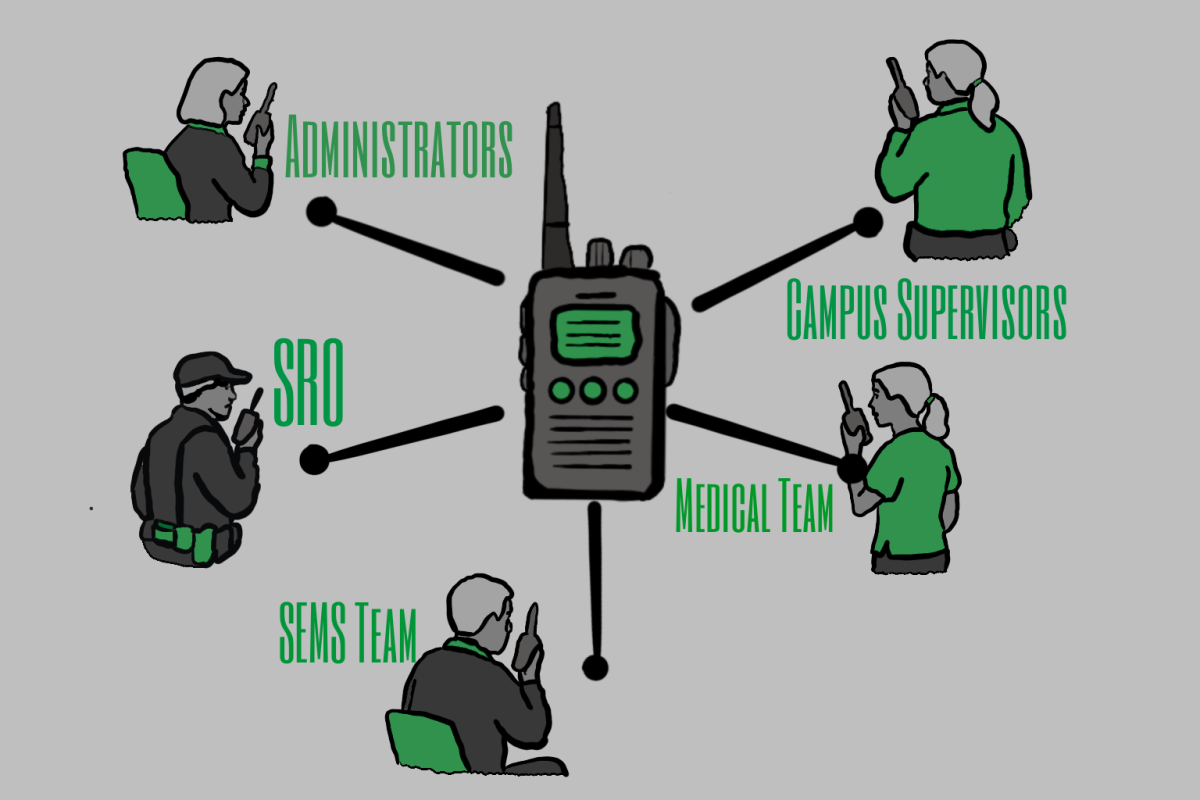
Beyond identification policies, communication is another important characteristic of a school’s safety effort. Campus supervisors and administrators rely on radios to stay connected throughout the day, allowing for rapid response when situations happen.
“Since the CS’s (Campus Supervisors) have radios, we serve as a quick communication channel inside the building,” Bubb said. “We can provide quick communications to the Admin Team to relay what situations may be going on inside or outside of the building.”
This level of coordination allows staff to respond quickly, usually before students are even aware that there is a situation. It also shows what administrators describe as one of the school’s greatest assets: teamwork.
“We trust each other’s judgment. That partly makes a great team, but we just have great people,” Folden said. “It is one of our strengths, and one of the things that I think we’re most proud of is just the teamwork of this group of people. I’m really proud of this team that we have assembled.”
Still, one of the most visible parts of school safety comes in the form of drills. Fire drills, lockdown drills and evacuation drills are designed to help students in the case of emergencies – but reactions to these can feel mixed. For some students drills feel repetitive or unnecessary. For administrators, however, they are essential.
Drills can feel tedious; LSE must perform at least 10 fire drills, and two drills for everything else throughout the school year. These drills are extremely important, and very valuable for safety.
“When we start with evacuation drills in the fall, it’s around five or six minutes,” Folden said. “By the time we get to spring, we’re down to four minutes to evacuate the building. And four minutes makes a difference. What if there is truly a fire? Our job is to ensure safety.”
The goal is not just speed, but to get familiar with it. By repeating these drills in different situations, which could mean different classrooms, or different times of the day, students are exposed to a variety of these scenarios.
“There’s less pandemonium, if the real deal happens,” Folden said. “Making people feel more comfortable with it, giving them exposure to different areas, different places where you go, what you do, that exposure is one of the goals.”
Campus supervisors also share this perspective, comparing drills to other forms of preparation that most people don’t think about.
“These drills are like buying insurance,” Bubb said. “You go through the process hoping to not have to use them, but you had better be ready in the event that a live situation happens and the students need to act quickly and decisively.”
In addition to the drills and supervision mentioned, technology has become an extremely important tool. Cameras positioned at entrances and throughout the building allow staff to monitor activity and respond to potential concerns. Yet even with these systems in place, administrators know that not one single measure can guarantee full, complete safety. Instead, the school relies on a combination of strategies, like policies, technologies, communication and human awareness, all to create a safe environment for the people at LSE.
At LSE, these actions are visible in small everyday moments. Like teachers greeting students at the school, supervisors positioned throughout the halls, radios sending quick updates and drills that gradually become more efficient throughout the year. For students, these efforts may not be obvious, and they might not even feel like they are necessary, but for the staff responsible for maintaining safety, each action serves a specific purpose. So for LSE, the answer for the protection of these students lies in the actions that the staff takes daily, and how the staff makes it certain that students are ready for anything.